Tuesday, May 27, 2014

DEATH WAS ALWAYS WITH THEM

Thoughts and Ramblings

I feel as though I have advanced beyond the mere collection of dates. 
Many questions have arisen like: how did my ancestors live, and of course, how did they die? How did my ancestors deal with the death that was all around them?  What about medical terms, herbs, influenza, cholera, tuberculosis, fevers, death at childbirth, burial methods, gravestones, the culture of death, and on and on and on!

Some readers may not approve of some of the photographs that I have chosen to post.
However, it's my blog.  I need to tell the story as it was and is - so on with the 
Thoughts and Ramblings!


FUNERALS
I remember funerals being taken seriously.  I was young when my paternal grandfather died in 1964, but I remember it as if it were yesterday. I remember the somber reality of death that was with our family and community. I remember the 'quiet' in the funeral home.  The reverence.  
I remember the funeral.  Family.  Love.  

Within the plethora of photographs that belonged to my parents, I have found many with the family members standing/posing at the gravesite of their departed.  
Families.  Together.  What were the messages behind these photographs?  Why do families no longer (or seldom) get photographed in this manner?


This photo was taken after the burial of my "Pappy" 
(Paternal Grandfather - William Luther Allison)


The photos below are from my 
Maternal Grand Uncle's Funeral
SGT. Sim Herron (1918-1945) 
Died at the age of 27 in WWII Co E 27th Infanty Div


I remember hearing my family talk of Sim's death, but I don't recall any 'specifics' -
 they usually just spoke of dying at such a young age.  Tragic.


Memorial Portraiture
Beginning in the mid-1800s, post-mortem photography (or memento mori) was a popular way to honor and remember 
the dead.  Most photographs were taken shortly after 
death, and could look incredibly life-life, especially if 
the deceased was propped up into a standing position. 
Post-mortem photos of children were particularly 
common, perhaps because their mortality rate was high.
So, when I ran across this photo, and realized the name actually written on the back … well, it's hard to describe.  I'm still trying to figure out how I actually feel about this type of photo. 


Below is William Luther Allison JR ~ Died at the age of 18 months
(Paternal Uncle)
Birth Certificate states cause of death was flux.
Flux was an excessive flow or discharge of fluid like hemorrhage or diarrhea.


  “...THIN dark trees through yon iron palings where dead keep their own small metropolis. Curious marble architecture, stele and obelisk and cross and rainworn stones where names grow dim with years. Earth packed samples of the casketmaker's trade, the dusty bones and rotted silk, the deathwear stained with carrion...” 
       -- From Suttree by Cormac McCarthy, 1992 

Childbirth
Childbirth in colonial America was a difficult and sometimes dangerous experience for women. During the seventeenth and eighteenth centuries, between 1 percent and 1.5 percent of all births ended in the mother's death as a result of exhaustion, dehydration, infection, hemorrhage, or convulsions. Since the typical mother gave birth to between five and eight children, her lifetime chances of dying in childbirth ran as high as 1 in 8. This meant that if a woman had eight female friends, it was likely that one might die in childbirth.

Death in childbirth was sufficiently common that many colonial women regarded pregnancy with dread. In their letters, women often referred to childbirth as "the Dreaded apperation," "the greatest of earthly miserys," or "that evel hour I loock forward to with dread." Many, like New England poet Anne Bradstreet, approached childbirth with a fear of impending death. In a poem entitled "Before the Birth of One of Her Children," Bradstreet wrote, 
How soon, my Dear, death may my steps attend,
How soon't may be they lot to lose they friend.


Given the high risk of birth complications and infant death, it is not surprising to learn that pregnancy was surrounded by superstitions. It was widely believed that if a mother looked upon a "horrible spectre" or was startled by a loud noise her child would be disfigured. If a hare jumped in front of her, her child was in danger of suffering a harelip. There was also fear that if the mother looked at the moon, her child might become a lunatic or sleepwalker. A mother's ungratified longings, it was thought, could cause an abortion or leave a mark imprinted on her child's body. At the same time, however, women were expected to continue to perform work until the onset of labor, since hard work supposedly made for an easier labor. Pregnant women regularly spun thread, wove clothing on looms, performed heavy lifting and carrying, milked cows, and slaughtered and salted down meat.

Today, most women give birth in hospitals under close medical supervision. If they wish, women can take anesthetics to relieve labor pangs. During the seventeen and eighteenth centuries, the process of childbirth was almost wholly different. In colonial America, the typical woman gave birth to her children at home, while female kin and neighbors clustered at her bedside to offer support and encouragement. When the daughter of Samuel Sewall, a Puritan magistrate, gave birth to her first child on the last day of January, 1701, at least eight other women were present at her bedside, including her mother, her mother-in-law, a midwife, a nurse, and at least four other neighbors.

Most women were assisted in childbirth not by an doctor but by a midwife. Most midwives were older women who relied on practical experience in delivering children. One midwife, Martha Ballard, who practiced in Augusta, Maine, delivered 996 women with only four recorded fatalities. Skilled midwives were highly valued. Communities tried to attract experienced midwives by offering a salary or a house rent-free. In addition to assisting in childbirth, midwives helped deliver the offspring of animals, attended the baptisms and burials of infants, and testified in court in cases of bastardy.

One of my cousins had a grandmother who was a midwife. 
I hope to learn more from her concerning the realities 
as it was here close to home. 


BURIAL POSITIONS


                                           In the words of Louis Simpson: 
                                          In this America, this wilderness 
                                  Where the axe echoes with a lonely sound, 
                                            The generations labor to possess 
                                  And grave by grave we civilize the ground.

As the frontier settlers moved westward intruding on Indian lands, the need for grave sites became inevitable. The family burial ground on the family farm was the first of the frontier cemeteries. The custom of family burial grounds kept its strong hold on the rural south, especially in the Appalachian and Cumberland Mountain areas. The local church cemetery came next, but while the family farm and the local church cemeteries were frequently surveyed, the determination of true east was not usually established. They simply did not have the luxury of good surveys, and it is unlikely that even a compass was used later to determine true east for the graves. Undoubtedly, the east direction was determined by sunrise and that changed every day of the year. 

In early land records, we often find disparities between legal descriptions and the actual surveys. The cause of this is declination, which is the difference between true north and magnetic north. (Longitude lines run true north - south, while the compass needle points to the magnetic north - at least on our north side of the equator.) Add to that, the early south used a survey system called 'meets and bounds' which was poor at best. Certainly we can not rely on the old surveying methods to provide the precision of today’s surveying systems. We must conclude that the grave direction was almost always based on someone’s opinion and not science. 

Potentially, the advent of city cemeteries, especially the later ones, may have allowed for more accurate west-east positioning of the graves. Of course, not all cemeteries were designed with the direction in mind.

More Thoughts and Ramblings Soon

“We are all the product of things we've never seen and people we never met. In fact, if just one little detail had been changed in their lives, we may not even exist!” 
― Melanie Johnston

Tuesday, May 20, 2014

9th Great Grandmother ~ ELIZABETH POYNTZ

ELIZABETH POYNTZ

Elizabeth Poyntz was born around 1587-88 in Somerset, England. 
Her mother, Elizabeth Sydenham died at the age of only 33 in Westminister, London, England.
Her father was Sir John Poyntz born 1530 of Acton in Gloucestershire.
Elizabeth's ancestral home was Iron Action Court (see picture below).

Iron Acton Court,  Gloucestershire
Elizabeth Poyntz's Ancestral Home

Elizabeth became Lady Thurles around 1608-1610 when she married Thomas Butler, Viscount Thurles, son of Walter, 11th Earl of Ormond.  Thomas was 14 when they married.
The marriage was against her father-in-laws's wishes.
They were probably the first of the family to take up residence in Thurles Castle in Ireland.
*Thurles was an ancestral home of Prince Charles and Lady Diana.

THURLES CASTLE

She and Thomas had three sons and four daughters before he drowned on December 15, 1619, when the ship carrying him to England was wrecked off the Skerries near Anglesey.  He was 23 years old. This was shortly after the start of his father's long imprisonment in the Fleet Prison in London and Thomas had been on his way to answer charges of treason for having garrisoned (defended) Kilkenny.

After Thomas' death, Lady Thurles married again, about 1620.  With her second husband, Captain George Mathew of Tadyr and Llandaff in Glamorganshire, Wales, she had two more sons and one more daughter. Her second husband died in 1638 in Wales.  Elizabeth lives a further 37 years, dying in Thurles, North Riding, Tipperary, Ireland in May 1673.  She was buried beside what is now the Protestant Church of St. Mary's in Thurles.


An oil portrait of Lady Thurles is held by Tipperary County Library in Thurles.
I wonder what 'Mine Lick Joe' would have thought of this painting?

Her body was interred beside St. Mary's Famine Museum Church in Thurles.


Elizabeth Poyntz -  9th Great Grandmother
daughter of Elizabeth Poyntz
son of Mary Butler
son of Alexander Hamilton
daughter of William Hamilton
son of Martha Hamilton
son of John Allison JR
son of Joseph "Mine Lick Joe" Allison
son of William Herbert Allison
son of William Carter Allison
son of William Luther Allison
You are the daughter of Ernest Haywood Allison 

Sunday, May 18, 2014

NO SMILES


'Smiling Faces Sometimes' by the Temptations
 go something like this ~
 Smiling faces, smiling faces sometimes
 They don't tell the truth.
(The key word in those lyrics is 'Sometimes')
People did not smile in old photographs!  
What was up with that?  Bad teeth?  
I'm sure that was true in some cases, 
but not for everyone and every picture!

Smiles were perceived quite differently centuries ago.  Although today we think of smiles as
being indicative of happiness, humor, and warmth, they apparently had very different
meaning back in the day:  "By the 17th century in Europe it was a well-established fact that
the only people who smiled broadly, in life and in art, were the poor, the lewd, the drunk,
the innocent, and the entertainment."  So if you wanted to be seen as upper class and
as a person of good character?  Don't smile.


 MORE POSSIBLE EXPLANATIONS FOR THE 'NO SMILING FACES'
Probably the biggest reason people didn't smile in old photographs was that the exposure time for the pictures was extremely long. It was very difficult for people to remain still for the period needed to create a clear picture, let alone to sit the entire time with a realistic-looking smile. It would take up to fifteen minutes for the photography to be taken.  In that time if the subject moved around then the picture of them would be blurry.  Since it's difficult to keep a smile in place for 15 minutes, photographers 
advised people to keep a straight face.

Getting a photo taken used to be fairly expensive, and thus it was a rare,
 formal occasion where people felt it would be inappropriate to smile.

Mark Twain, in a letter to the Sacramento Daily Union, wrote, "A photograph is a most
important document, and there is nothing more damning to go down to posterity
than a silly, foolish smile caught and fixed forever."

Abraham Lincoln, although known for his humorous personality during his time, 
is now remembered more by the extremely serious expressions he 
wore during official portrait sessions.

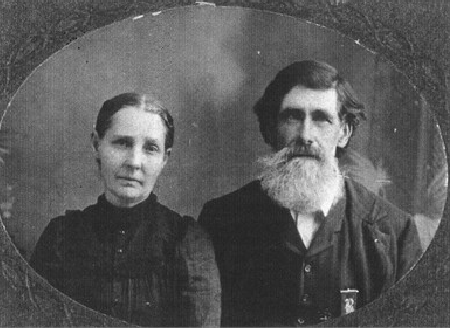
Nancy Ashburn Speck ~ No Smile Here
3rd Great Grand Aunt


John Speck ~ Definitely No Smile
Husband of Nancy


Mary Frances "Frankey" Ashburn Vaughn
3rd Great Grand Aunt
(I see an 'almost' smile on her face ~ I think I do...)


James Anderson 'Anse' Ashburn Family around 1900
2nd Great Grand Uncle
NO SMILING ALLOWED!


These 'NO SMILING FACES' ~
All are gone ~ the old familiar faces.


Our faces will one day 
be 'the old familiar faces'… 
familiar to someone - I pray.

Winfield Scott Burgess
(My husband's 1st Great Grand Uncle)


Leoma Mary Burgess Lollar
(My husband's 1st Great Grand Aunt)


Oh, the stories behind the faces ~ the faces with 'no smiles'.


Monday, May 12, 2014

FOUGHT FOR THE UNION ~ BURIED A CONFEDERATE


Isabelle Caroline Burgess & John Martin Lafayette Stone
Isabelle Caroline Burgess (My Second Cousin 3X Removed)


Isabelle was born in Bledsoe County, Tennessee, on August 8, 1852.  She was the daughter of Nancy Grace Campbell and John Hiram 'King' Burgess.  She married John Martin Lafayette Stone.  He was born  in Bledsoe County, Tennessee, on April 6, 1845.  They were married on August 28, 1866, in Tennessee (she was 14 and he was 21) and had 10 children in 21 years.  Isabelle died on January 6, 1914, in Bledsoe County, Tennessee, at the age of 61.  Lafayette married a second time. He died on January 8, 1929, in Fordland, Missouri, at the age of 83.

Isabelle Caroline Burgess (1852 - 1914)
is your 2nd cousin 3x removed
mother of Isabelle Caroline Burgess
mother of Nancy Grace Campbell
father of Martha "Patsy" Toler Allison
son of John Allison JR
son of Joseph "Mine Lick Joe" Allison
son of William Herbert Allison
son of William Carter Allison
son of William Luther Allison
You are the daughter of Ernest Haywood Allison 


  While researching Isabelle, my ancestor, I happened 
upon her husband's story.  A story of great sadness.  
Read on, my friends...


The Civil War officially began on April 12, 1861, and ended on May 10, 1865.
Lafayette served in the Civil War and enlisted around the age of 14.  
He was a member of the 2nd TN Infantry Company D.

(I have attached an affidavit stating that he did not know his exact age when he enlisted.)


What makes Lafayette's Civil War interesting?
Lafayette was buried as a Confederate (notice the CSA on the Confederate stone) ~ but was a Union Soldier. 
This mistake was corrected 75 years later.  
I respectfully share part of his story below.  

(I learned that Confederate stones were pointed on the top, 
and Union Stones were rounded at the top.)


HERE IS LAFAYETTE'S STORY
(excerpt taken from a story written by a Great, Great Grand of Lafayette)
[Funny what you can find out when you start searching your roots. I had tried for years to find my Great Great Grandfather, Lafayette Stone's Civil War records. I had visited his grave site many times, took pictures the whole nine yards. My cousin, Steve Ince's wife, Janice had tried also, but we both ran out of luck.
While vacationing in Washington D.C. one time, I went to the Archives building to get some copies of civil war and Revolution war records. I took a picture of Lafayette's stone with me. I showed it to one of the gentlemen sitting there as you enter the Archives. He said" you won't find his records here, that is a confederate stone, you will have to obtain those records at the state level. I really didn't know until then that confederate stones came to a point on top of the stone, and Union stones were round…]

[We went to Jefferson City, Missouri, the capitol of Missouri. We went to the Archives there and searched microfilm's and books, and the lady who was helping us told us that she didn't know why the records weren't there, because it was evident by the shape of the stone and what it had on it that he was a confederate.
So, once again, I was let down, no records found. Then I sat down at the computer one day and started google and put in Lafayette Stone, with the troop # ect. I found him listed under the survivors of Andersonville Prison in Georgia…]

I started researching Andersonville Prison. The more I read about this place, the more it made me sick. This was by far the worst Prison for either side, during the civil war. The prison was overcrowded by 5-6 times it's intended capacity. The Confederate's mainly put the Union soldiers in the prison and forgot them. Most died, very few made it out alive, and most of those suffered bad health the rest of their lives. I was appalled.
Then I started thinking, how terrible it was that Lafayette Stone fought for and was true blue to the Union, thrown into a hell hole called Andersonville, survived and lived to tell about it, and was buried under a confederate gravestone. I do not and may never find out how that Confederate stone got placed there, who ordered it, ect. But, I knew I had to make it right…] 

[I contacted the people who set stones in cemeteries and set a date to change the stone. I got to thinking that 
We watched as the men removed the old confederate stone and set the new Union stone. It was very moving when the military team shot the guns and performed the flag folding ceremony, but when they played "Taps", that really moved me, and I felt good inside that I had made a wrong right. I knew Lafayette would never know about the mistake, but I know and that makes me feel good to have been a part of this…]

Lafayette and Isabelle Stone are buried in Cass Chapel Cemetery, between Fordland and Marshfield, Missouri. 
I have found out a lot of interesting things with this genealogy hobby, but, this was one of the most interesting by far. I hope to some day find out who ordered the confederate stone and why. ~ Judy Bench}

What an amazing story. Way to go, Judy Bench!


CASS CHAPEL / Cemetery - Missouri

Burial Site for Lafayette and Isabelle


Affadavit of Lafayette's Date of Birth


ANDERSONVILLE PRISON

Andersonville Civil War Prison, located in the village of Andersonville, Sumpter County, Georgia, became notorious for its overcrowding, starvation, disease, and cruelty.  It was in operation from February 1864 to April 1865.

Andersonville Prison was established as a "stockade for Union enlisted men".  The prison consisted of 27 acres and was enclosed with walls made of pine logs, which stood 15-20 feet high.  The "stockade" held a hospital but no barracks were ever constructed for the prisoners.  Originally intended to hold 10,000 men, Andersonville at one time held over 33,000 men.  According to records, a total of 49,485 prisoners went through the gates of Andersonville Prison.

Prisoners suffered from hunger, disease, medical shortages, and exposure.  The death rate at Andersonville was the highest of all Civil War prisons.  A staggering 13,700 men died within thirteen months!

The superintendent of the prison was Captain Henry Wirz.  It is said he was heartless and high-handed.  John L. Ransom, a Michigan sergeant and Andersonville prisoner, wrote in his diary on May 10, 1864:  "Captain Wirz very domineering and abusive, is afraid to come into camp any more.  A thousand men here would willingly die if they could kill him first.  The worst man I ever saw."  Captain Wirz was tried and hanged by a military court after the war.  (Just before he was executed by hanging in Washington, D.C., on November 10, 1865, Wirz reportedly said to the officer in charge, "I know what orders are, Major.  I am being hanged for obeying them."  The 41-year-old was one of the few people convicted and executed for crimes committed during the Civil War.)

Andersonville Prison was investigated by the Confederate War Department and they recommended that the majority of the prisoners be transferred to Florence, SC and Millen, GA.  This mere fact would attest to the horrors suffered by prisoners at Andersonville.

The prisoner's burial ground is now a National Cemetery and contains 13,737 graves, of which 1,040 are marked unknown.  The area is now designated as a National Park and can be visited.  Visitors will experience a great sense of sorrow upon seeing this vast number of graves.


There are many photos available ~ sad, deplorable... 


Judy Bench wrote of Lafayette's Experience in Andersonville Prison
"First let me tell you what I have read and seen in a movie about Andersonville Prison. There were guards posted every so many feet apart all around the walls of Andersonville. These guards were in towers attached to the walls. Inside the walls there was a line drawn a few feet from the wall called the dead line, because anyone who dared to cross that line was shot - no questions asked. Robert Stone, a grandson of Gilbert Stone (that family line is :Lafayette>Thomas>Gilbert>Robert>Robert) told of a story he remembers his grandfather, Gilbert telling. Gilbert said that Lafayette was so weak while in Andersonville,he couldn't walk very well and came so close to the dead line and  he fell over the dead line. The guards raised their guns and aimed, but for some reason didn't shoot him."

The stockade at Andersonville was hastily constructed using slave labor, and was located in the Georgia woods near a railroad but safely away from the front lines. Enclosing some 16 acres of land, the prison was supposed to include wooden barracks but the inflated price of lumber delayed construction, and the Yankee soldiers imprisoned there lived under open skies, protected only by makeshift shanties called shebangs, constructed from scraps of wood and blankets. A creek flowed through the compound and provided water for the Union soldiers; however, this became a cesspool of disease and human waste.
Some days, more than 100 prisoners died. 
This mass grave at Andersonville vividly illustrates the reality of Civil War prisons. 

The Cuban bloodhound (attack dogs) was used to guard the prison at Andersonville.  
This dog's name was Spot.  He stook three feet at the shoulder and weighed 159 points.  
With that size and aggressive disposition, he must have been quite a dangerous animal.  
This breed is extinct…and that's a good thing!


Death Certificate of Lafayette Stone


FINALITY - BATESVILLE CASKET CRANK

I  remember the day this  ‘casket key’ (sometimes called a burial vault key) was handed to my daddy at my grandfather’s burial in March of 1...