Sunday, January 18, 2026

FINALITY - BATESVILLE CASKET CRANK

remember the day this  ‘casket key’ (sometimes called a burial vault key) was handed to my daddy at my grandfather’s burial in March of 1964.

Being nine years old, I did not think much about it at the time.

I am always ‘going through’ boxes of memories; and there it was.


This is a specialized hex-head wrench used for two main purposes: locking the casket and adjusting the bed (the interior platform the body rests on). They are designed to look decorative because they are sometimes used in front of families.

In many traditions, the locking of the casket is a significant emotional moment marking the ‘finality’ of the service. Funeral homes usually keep these as tools (after further investigation - I found markings, etc. that signals this was not a universal wrench/key. Could that have been why it was given to my daddy?

According to research, it has become a modern tradition in some areas to present the key to the next of kin after the casket is locked as a symbolic gesture of ‘keeping their loved one safe’ or as a promise that the rest will not be disturbed. 

I loved my grandfather - William Luther Allison (1876-1964). 

I love finding keepsakes - memories of a precious times.


Whether or not this is common - I have never seen another ‘key’ handed to anyone . . . at any burial. Perhaps I will. Beautiful - to me.

Anna Allison-Burgess

January 18, 2026


Thursday, April 4, 2024

The Beauty of Growing Older - Beyond the Wrinkles


My 69th Birthday is April 6th - quite the privilege. 


For many years I have written something about my approaching birthdays. 

Here I am again - Writing. Thinking. Smiling. 


I love to ‘announce’ my birthday is approaching - my church family has been

 reminded almost every Sunday for the past two months.  I’m blessed with family 

and friends that I love and they love me. Getting older is a good and pleasant 

thing for many reasons. If you know me at all then you know that here 

comes some of those ‘reasons’ and simply some ‘thoughts’ on my life…


First of all - 

  1. Once you are on an airplane, you are there until it lands. Not one thing can you do about that. Get it?
  2. Most of us get shorter as we age; however, my explanations get longer and longer and longer. I just have a lot to say.
  3. We are never to old to set another goal or dream a new dream - C.S. Lewis
  4. It may be true that as we age we are gently nudged off the stage (I don’t nudge well), but it is quite comfortable being a spectator. I agree with Confucius on this one.
  5. We don’t have to keep a straight face in public - at least I don’t. Just let it out!
  6. I have never regretted becoming a teacher. Not one time. 
  7. Make-up is optional (well, sometimes it is). 
  8. I fall asleep (if I’m not driving of course) almost the minute I begin riding in the car. That’s a great thing.
  9. Sometimes we may seem a bit manic or fall asleep with our company - again, it’s a good thing because you’re old so the people around you will just figure it’s your meds or aging anyway. 
  10. I can smile at people and they will never know what I’m really thinking. That’s really a good thing. 
  11. I can’t stay up late - nor do I want to. 
  12. The length of my naps is no one’s business.
  13. I think I’m smarter now, but sometimes I can’t remember what I’m supposed to know.
  14. I love it when someone tells me I smell good.
  15. If I believe something, I really, really believe it.
  16. If I like you, I really, really like you. The opposite might also be true.
  17. My dream of a second career as a homicide detective has been put on hold.
  18. Aging is a totally wonderful excuse of … well, lots of things.
  19. I believe that wearing one’s pajamas all day is acceptable and practical.
  20. No one gives me a strange look anymore when I tell them that I study dead people. 
  21. I will bite anyone that hurts someone that I love.

So far, regret has not taken the place of dreams in my life.


Birthdays are simply wonderful - quite the blessing if you ask me…and I haven’t bitten many as of lately! 


Friday, November 17, 2023

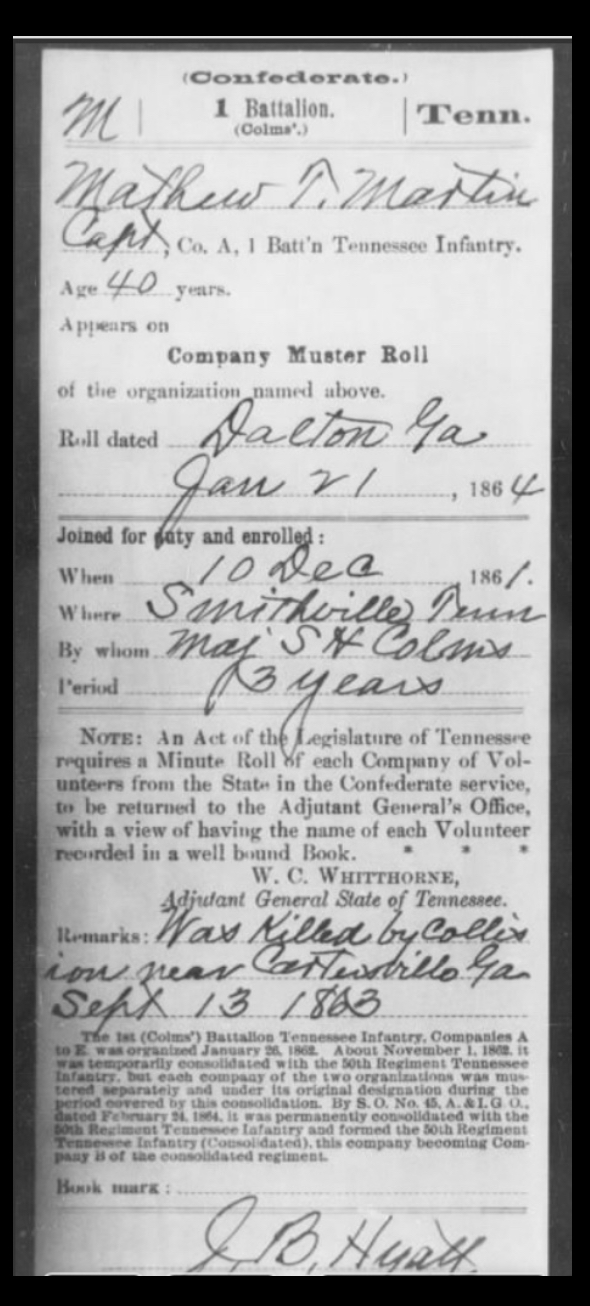
The Great Train Wreck of Sunday, September 1863 - CAPTAIN MATTHEW T. MARTIN

MATTHEW T. MARTIN
MY 3RD GREAT GRANDFATHER
Killed in this train wreck.

Emerson’s Forgotten Train Wreck

The Midnight Collision of the Chiefton and Senator

By Joe F. Head

 The Great Train Wreck of Sunday, September 1863, may be more of Emerson’s exclusive claim to Civil War railroad fame than the celebrated 1862, Great Locomotive Chase that once raced through the old iron ore mining community. Emerson was originally a wood stop along the Western and Atlantic road known as Stegall Station. It was initially a single boxcar depot named for Emsly Stegall a wealthy landowner, but later renamed for the Civil War Governor, Joseph Emerson Brown.

The northbound Senator, engine number 41, was transporting fresh confederate troops to Chickamauga, while the southbound Chiefton number 42 was evacuating wounded from the northern battlefields. In the haste of warring activities these two peacetime locomotives were pressed into evening service, but only to become silent victims of a fatal collision and eventually lost to history.

For Emerson and Stegall Station, the Great Locomotive Chase starring the locomotive General was but a fleeting non-stop moment in April of 1862 that added no credential to the ore rich community as it did in other towns and depots. But, the 1863 Great Train Wreck some 18 months later was a much more significant event that brought the reality of the Civil War to the heart of local residents.

images

Stegall House, Hwy 293, Emerson, GA      Deep cut 1/2 mile north of Emerson south of Hamilton Bridge

The American Civil War was the first war to be fought on the shoulders of a railroad. Stegall Station (now Emerson) was on the lifeline of the Confederacy and saw heavy rail traffic between Atlanta and Chattanooga. Many of the state owned engines noted in the war traveled Western and Atlantic tracks through Stegall Station. Perhaps the most famous of those were the locomotives, “General and Texas.”

The Texas is now on display at the Atlanta History Museum and the General at the Southern Museum of Locomotive and Civil War History in Kennesaw. Following the Civil War the Texas was often assigned in Emerson to serve mining transport needs and other businesses.

senator

Both the Senator and Chiefton were similar to this profile of the General

Southern rolling stock and rail lines were in poor repair in the final years of the war. Neither engine, Senator or Chiefton, was equipped for night running and should not have been in service. Lacking kerosene headlamps and little benefit of moonlight the two collided head on about midnight. The Senator was running behind schedule due to a previous derailment earlier in the day near Big Shanty (Kennesaw) and no message was telegraphed north to warn southbound traffic. Both trains were likely running at maximum speeds of 18 to 20 miles per hour during those years. The railroad bed, rails and cross ties could not support fast speeds and when combined with night running led to tragedy and loss of life.

The accident occurred in the dead of night in what is known as the deep bank cut a half-mile north of the community near the SR 293 Connector-Hamilton Bridge adjacent to what is now known as the old Dixie Highway. Both steam-powered engines, the Chiefton piloted by Mr. Howden and the Senator piloted by Mr. Schofield, were fueled by wood and water.

Local residents were awakened by the crash and rushed to the site. Bodies were strewn along the tracks, most were injured and many dead. Southbound soldiers were wounded from the gathering battle at Chickamauga and the violent crash killed and injured others on both trains. Residents were overwhelmed with rescue duties trying to respond for requests for water, blankets and first aid.

According to a personal 1930’s story related by Mrs. Laura Jane Duckett Wigley, to her great grandson, Don Monroe, she recalls the startling noise and events that followed. Her father worked for the railroad and recognized what had happened. Mrs. Wigley was a young girl at the time, but states…

We went to see what had happened and discovered that, indeed, two trains had collided in the deep cut. The engines were lying on their sides and the rail cars were shattered in the bottom of the cut. There were many injured people in the wreckage and they were crying out for help and particularly water. We gathered buckets and pans and carried water up the road and down into the railroad cut. We learned from the survivors that the train coming from the north was loaded with wounded soldiers and the train from the south carried soldiers that were headed into battle. “

Casualty reports vary regarding the number killed and wounded from the collision. Personal letters about the accident cite confusing casualty numbers because they were reporting injuries by military units aboard both trains and not as a total of the event. Witnesses were inconsistent about who was injured as a result of the crash vs previously wounded.

The dead were buried in a small cemetery near the site. Nine days later the remains were removed to the Confederate Cemetery in Marietta. Only brief inscriptions on random head stones were inscribed indicating the date of death resulting from a train wreck. Estimates are unclear, but claim that 12 to 18 bodies were transferred. Sketchy reports on the event imply that the crash scene delayed traffic for one day before rail operations could resume.

Both engines were repaired, put back into service and eventually transferred by the state along with other rolling stock to a lease contract after the Civil War under Joseph Brown. Twenty years later the lease was transferred to the Nashville Chattanooga & St. Louis Railroad. The wartime Dixie Flyers were retired and sold off for scrap as was the fate of many engines to support WWI and WWII.

The wartime collision of the Chiefton and Senator was scarcely recorded and became a forgotten episode to the pages of Emerson history. However, the Great Train Wreck event, if considered in retrospect, deserves to be remembered and belongs exclusively to the history of Emerson and Stegall Station.

Sources

Books

Johnston, James Houstoun, Western and Atlantic Railroad of State of Georgia, 1932

Powell, David, The Chickamauga Campaign: A Mad Irregular Battle. 2014

Interview/Stories

Monroe, Diane and Monroe, Don, Interview/Etowah Valley Historical Society Presentation, Cartersville Library, March 11, 1997

Wigley, Laura Jane Duckett Durham, Documented childhood story shared with grandchild Don Monroe in the 1930’s

Manuscript

Author unknown, History of Emerson, Document on file in Emerson City Hall, found by Patsy Bradbury and Marion Foster, April 4, 1994.

Pamphlet 

Ratledge, Curt, “On the Western Atlantic Railroad to Chickamauga: The head-on collision between locomotives “Senator & Chieftain,” February 23, 1997

______________

Note: It should be noted that Chieftain is spelled differently in several accounts, but is spelled as Chiefton in the W&ARR inventory schedule between 1843 and 1872.

Article compiled March 1997, updated June 2016


Opened in 1863, the Marietta Confederate Cemetery is the final resting place for more than 3,000 soldiers. Mrs. Jane Porter Glover donated a corner of her property for the burial of 20 Confederate soldiers who died in a train wreck. Every Confederate state is represented, as well as Kentucky, Maryland and Missouri, and the cemetery remains the largest Confederate cemetery south of Richmond. A large number of the buried soldiers fought nearby in The Battle of Kennesaw Mountain and The Battle of Kolb's Farm.


Thursday, July 20, 2023

HART TO HEART

 JULY - 2023

Clinton, Oklahoma

HART FAMILY REUNION

A Brief Overview - More Informative Post Will Follow Soon!

I had never met anyone from this family in person - a letter, a few brief phone conversations and messages. My Daddy knew he had cousins in Oklahoma, but knew nothing about them. Upon arriving at The Hart Family Reunion, I felt as if I knew everyone. 

One would be hard pressed to find a more genuine, 

kind group of people. The importance of family and connections were real here. 

I was touched at the scenes of groups - in each circle a variety of generations 

of smiles, laughter, and stories being shared - especially by what you might 

say were the ‘seasoned’ members in the group. My heart smiles as I think

of the power experienced for each person as they were enjoying the present - 

as well as the past. Getting together and experiencing the amazing benefits of 

connecting with ‘who you really are’ is therapeutic. Restores the soul. 

This I know . . . years from now one may care and want to learn as much as

much as possible about family, but may not have those family members still 

around to share and tell the tales. How blessed I am to have attended this reunion.  

Bonds created - my heart softened and strengthened - through connections made. 

My connection to the Hart Family from Oklahoma was through a 

First Cousin 2X Removed, Deanna Allison Hart. Deanna’s Father was

my Great Granduncle - Abraham Monroe Allison. Abraham moved from Tennessee

to Oklahoma arriving at The Cherokee Nation in November of 1889 from Tennessee 

with his wife (Geriah Thomas Allison) and daughter (Deanna). 


The event was well-planned - exciting and meaningful.
A time to reunite/unite and celebrate the things we cherish.

GAMES
I was introduced to “Chicken Foot Dominos”.
This crew is S.E.R.I.O.U.S. about their Chicken Foot Domimos!
I had never seriously played ‘any’ kind of dominos - but, I didn’t finish last - just almost last. 


TALKING AND SHARING AND EATING 
AND REMINISCING 


Les (Deanna’s Great Grandson) has the ALLISON eyes.
Identical color of my Grandfather and Father. 

DRIVES

.
RED STAR CEMETERY - Leedey, Oklahoma
Burial Site of Deanna and many relatives.

Below are photos of the actual site in Leedey, Oklahoma, where 
William Thomas Hart and Deanna raised 
their children - Minnie, Ada, and BusterMy cousin Lisa 
and her husband Charlie graciously took me to this site.
A tornado in 1955 destroyed everything in this area.

My heart melts. 
I see them here. Working and playing


Notice the storm cellar in photo below. 
Also, what a beautiful smile Deanna has on her face!

OLD PHOTOGRAPHS


I know that my Daddy is smiling right now. 

Anna Faye Allison-Burgess 09.20.2023


Friday, March 17, 2023

FUSON FAMILY


Bell County is located in the southeastern corner of Kentucky where the state meets Tennessee and Virginia at the famed Cumberland Gap. Its 361 acres are dominated by two mountain ridges, Pine Mountain and Cumberland Mountain. Much of its rugged terrain is thickly forested with picturesque streams cutting through deep valleys. Rugged terrain . . . That’s a BIG YES. Many of the roads in this mountainous area were almost impossible to navigate - along with some truly sad and neglected areas. However, it was one of my favorite day trips to date dealing with my ancestors. 

My research focused on my FUSON ancestors of southeast KY. The Fuson Family came from England and eventually settled in Hanover County in Virginia. 

Thomas Fuson, my 5th Great Grandfather (born in 1765 in Hanover County, Virginia) was the
progenitor of the Fuson/Fuston family in southeastern Kentucky … 
settled in the Chenoa
area (
marrying Rachel Permelia Robinson in Liberty, Tennessee, in 1791). 

Thomas 
Fuson was a son of John and Elizabeth (Wheeler) Fuson of Hanover County, Va. 

Thomas has been approved as a Revolutionary War ancestor for DAR membership.

Questionable story says he froze to death in 1849.


GREAT READ…
pdf version of History of Bell County, KY by H.H. Fuson
http://www.bellcpl.org/uploads/4/2/6/7/42679073/history_of_bell_county_kentucky.pdf


                     Following are maps of the three different cemeteries visited.

FUSON CEMETERY #4 - located in Frakes, Bell County, KY


A HISTORY OF KENTUCKY AND KENTUCKIANS                                                             By E. POLK JOHNSON1912 The Lewis Publishing Company

Transcribed by Kim Mohler 

JUDGE BETH A. FUSON 

The present able incumbent of the office of judge of Bell county, Kentucky, is B.A. Fuson, whose public-spirited interest in all that pertains to the well being of this section of the fine old Blue Grass commonwealth has ever been of the most insistent character and whose various business enterprises have been an important element in general progress and development.
Judge Fuson was born in that part of Knox county which now forms a portion of Bell county, Kentucky, the date of his nativity being the 14th of December, 1858. He is a son of James R. and Lucinda (Evans) Fuson, the former of whom was born in the state of Tennessee, in 1822, and the latter of whom was born on the same old homestead farm as was the Judge, her birth having occurred on the 15th of February, 1819. Mr. and Mrs. James R. Fuson became the parents of six children, and of the number five are living at the present time, namely – James A., Mrs. Letitia Smith, J.T., B.A. and H.J., all of Bell county, Kentucky. The paternal grandfather of the Judge came from his native state of Tennessee to the head of Bear creek, Bell county, Kentucky, at an early day on a hunting expedition. He was lost from his family for a period of two years and was then recognized by some hunters; his family was notified and he was looked up. He then removed his family to Kentucky and there resided during the residue of his life. James R. Fuson was a farmer by vocation and at the time of his death, on the 24th of March, 1864, he was incumbent of the office of magistrate. In politics he was originally an old-line Whig but at the time of the organization of the Republican party he transferred his allegiance to its principles and policies. His cherished and devoted wife, who long survived him, passed to eternal rest on the 10th of February, 1902.
After completing the curriculum of the district schools of his native place Judge Fuson continued to be engaged in the work and management of the home farm until the 25th of May, 1887, at which time he came to Pineville, where he turned his attention to the general merchandise business. He continued to be identified with that line of enterprise for the ensuing four years, at the expiration of which his place of business was destroyed by fire. He was then, in 1891, elected to the office of chief of police, in which connection he served for one year, when he resigned in order to accept the position of magistrate, to which he had just been elected. He was magistrate for four years and then made the race for the office of police judge, but was defeated. In the next election he was again candidate for police judge and then he was successful, serving for four years, his regime being marked by conscientious devotion to duty. His next public office was that of deputy circuit court clerk, which he held for four years. In November, 1909, he was further honored by his fellow citizens in that he was then elected to his present position of county judge. He assumed charge of the affairs connected with this position in January, 1910, and in discharging the duties connected therewith is acquitting himself with all of honor and distinction. Judge Fuson initiated his independent business career as a teacher, following that line of occupation for a period of five years. He was also deputy United States marshal for twenty-six months prior to his election as police judge.
In the year 1892 was solemnized the marriage of Judge Fuson to Miss Alice B. Coppock, who was born at Grundy Center, Douglas county, Illinois, and who is a daughter of W.H. Coppock. To this union have been born eight children, seven of whom are living and all of whom are at home – Sylvia G., Ida L., Ollie Lucinda, Lola, Alice, Mary, Myrtle and B.A., Jr. The child deceased is Ida L., whose death occurred September 9, 1900. Judge and Mrs. Fuson are affiliated with the Baptist church in their religious faith and they are zealous and ardent workers in its behalf.
In his political convictions Judge Fuson is allied as a stanch supporter of the cause of the Republican party, in the local councils of which organization he is an active factor. He has always been prominent and influential in public affairs, as already seen, and his service as an official has ever been characterized by faithfulness and marked ability. During his regime as judge very few of his decisions have ever been appealed and all his rulings are influenced by that stern sense of justice which is so potent an element in the enforcement of the law. Fraternally he is connected with the local lodge of the Junior Order of United American Mechanics, of which he is secretary at the present time, and he is also a valued and appreciative member of the time-honored Masonic order. As a man he is genial, kindly and markedly courteous, thus winning the love and unalloyed esteem of all who know him. He is straightforward and honest in all his business dealings and in public life he holds an untarnished record.


FUSON CHAPEL CEMETERY, Bell County, KY 
      Located beside Fuson Missionary Baptist Church


Chenoa Cemetery, Bell County, KY


and as always … Anna

FINALITY - BATESVILLE CASKET CRANK

I  remember the day this  ‘casket key’ (sometimes called a burial vault key) was handed to my daddy at my grandfather’s burial in March of 1...